
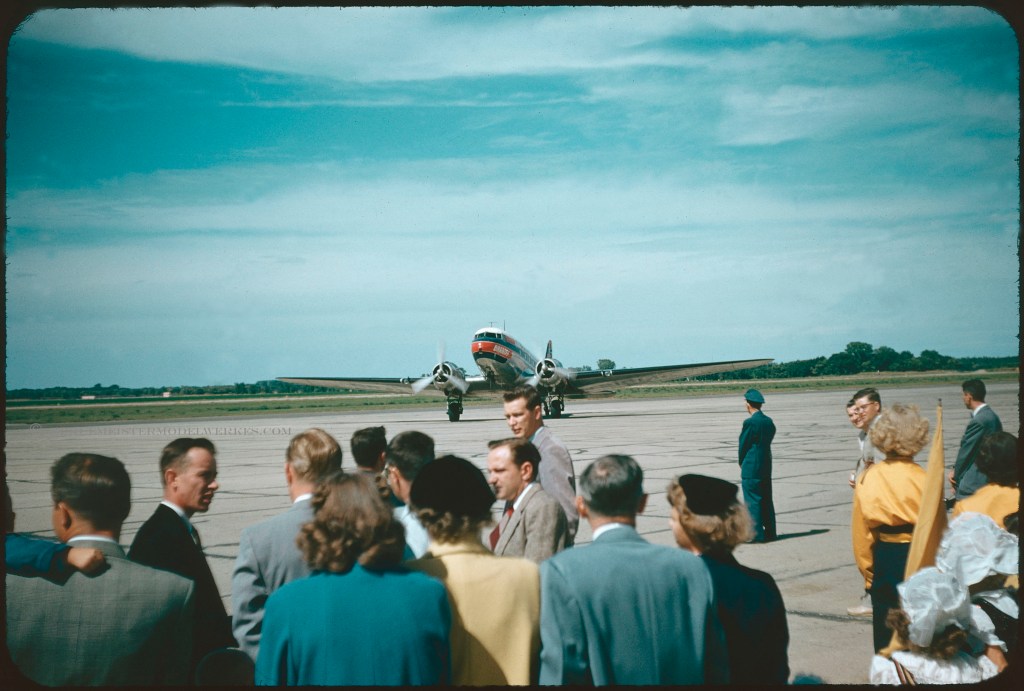
It is Valentine’s Day. And while this might not seem like a really obvious occasion to mark on a scale modeling/aviation history heavy blog, eh. Sometimes you just have to go where the rabbit trail leads. And as I have mentioned here before, that is sometimes just how things go for me with the hobby of old images and model projects. I’ve learned that it’s just best to go with it and learn something. It rarely disappoints. This story actually grabbed my attention initially because of the airplanes and what looked like a very important event happening at an airport not all that far from where I live. Old prop airliners are cool and my attention was quickly locked in on these Kodachrome slides showing an important arrival of a Braniff Airways DC-3 at the Sioux City, Iowa Gateway Airport sometime in the 50s. But why? What was the back story for what is going on here? Well as it turns out, the story is long at eight years and quite detailed with twists and turns, unforeseen dangers, determination and unfailing loyalty. And true love. There is much more to this story, so much so that a book would probably be the best treatment of it. Maybe it would be best then to take a page from the plan of the enigmatic romantic himself, Inigo Montoya and “let me ‘splain. No, is too much. Let me sum up.” The Princes Bride. Still one of the best dude approved romance movies for viewing by historians who build scale models. Onward.
Libuse Hrdonkova was born in 1922 in the village of Stod in Czechoslovakia. Never having much while growing up, she did what she could to help with the family farm plot, and later remarked that while it wasn’t much, she and her family were happy. As she turned 16 in 1938, more hardships came along in the form of the Nazi occupation of her country. She was eventually forced to work in an ammunition factory under the harsh oversight of the Germans and the atrocities that came with them. She did what she could for those she worked along side in the factory. Many were from elsewhere in Europe. She would even throw bread to people on trains that she didn’t know, or where it was they were going. She would not know until much later that they never came back. All the while she had hope that things would get better again. In 1945 they did. The U. S. Army arrived in western Czechoslovakia bringing liberation from the Nazis. Along with them came relief from the oppression of the war, and a 20 year old truck driving corporal named Leonard Cloud.
Leonard was born in 1924 in Sioux Falls, South Dakota. There is little else to be known about Leonard until we find him in the Army in WWII in liberated Czechoslovakia on occupation duty. At a dance in Stod in 1945, Leonard and Libuse meet. Boy meets girl. Boy and girl date. Boy and girl figure out through using limited German words and drawing pictures that they would prefer to spend the rest of their lives together and make plans to do so. It is at this point that Leonard and Libuse (at some point becoming known hereafter as Lela) get engaged with plans to marry and move Lela to the US. But before that can happen, life intervenes. Leonard is re-assigned home on September 9th, 1945, and his unit makes it back to the US in November. He is discharged from the army at Sioux City in December of 1945. The couple continue to write letters while love grows, and Lela uses the time to learn English. Whatever hopes the two had of reuniting quickly comes to a crashing halt in February 1948 with the Communist takeover of Czechoslovakia backed by the Soviets. The Iron Curtain falls on the international romance as darkness descends on eastern Europe. Lela is cut off from her fiance, and the oppression of the past war comes back for the second time in her life. Every promise made by the Communists is a lie. Life is dictated at every level, and the border is closed with obstacles to keep people in and out. Not much is known as to the “how”, but in 1949 at great personal risk, our hero Leonard shows up in Pilsen to make good his pledge, and he and Lela are finally married. For a few months at least, they have each other, their love, and a life of promise. But it’s still not permanent. Leonard’s visa expires and he is forced to leave. Without Lela. With her heart breaking, she is denied an exit and Leonard departs in January of 1950.
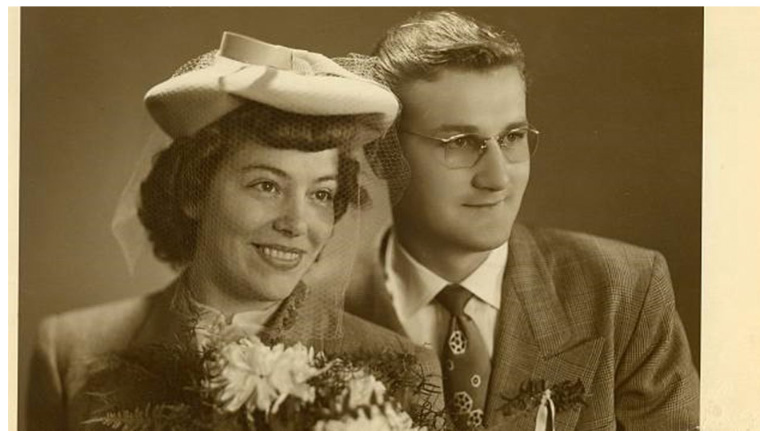
photo-Leoly Miller archive
Day to day life for Lela on the wrong side of the Iron Curtain is as you can imagine. Lines in town every day just for the right to receive a loaf of bread. No meaningful work worth any meaningful pay, and suspicion around every corner. The government owned everything leaving its citizens in a slavery like existence. Lela makes several attempts on her own to walk out of Czechoslovakia, but she is thwarted every time. There is not much left of hope. Most people would give up. Lela wasn’t most people.
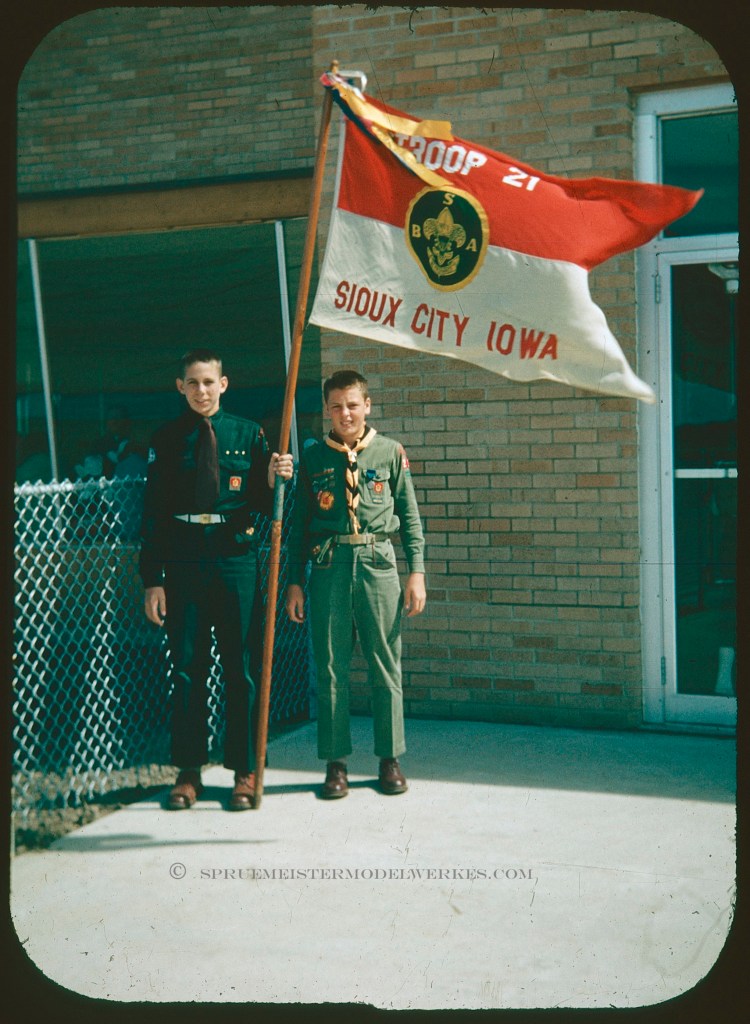
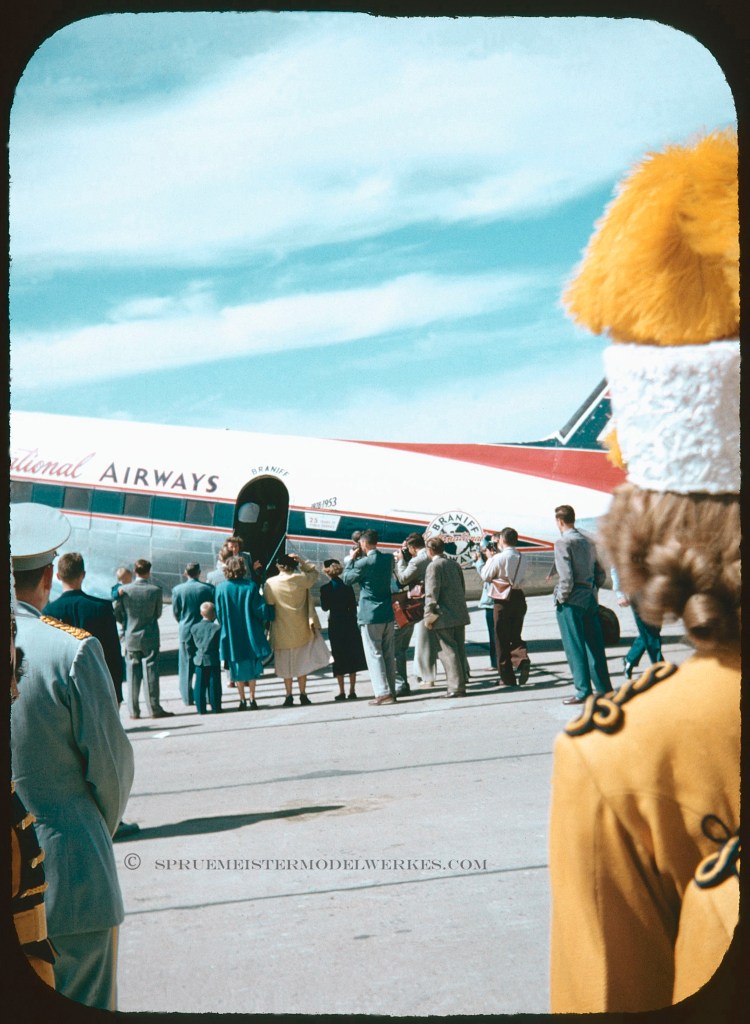
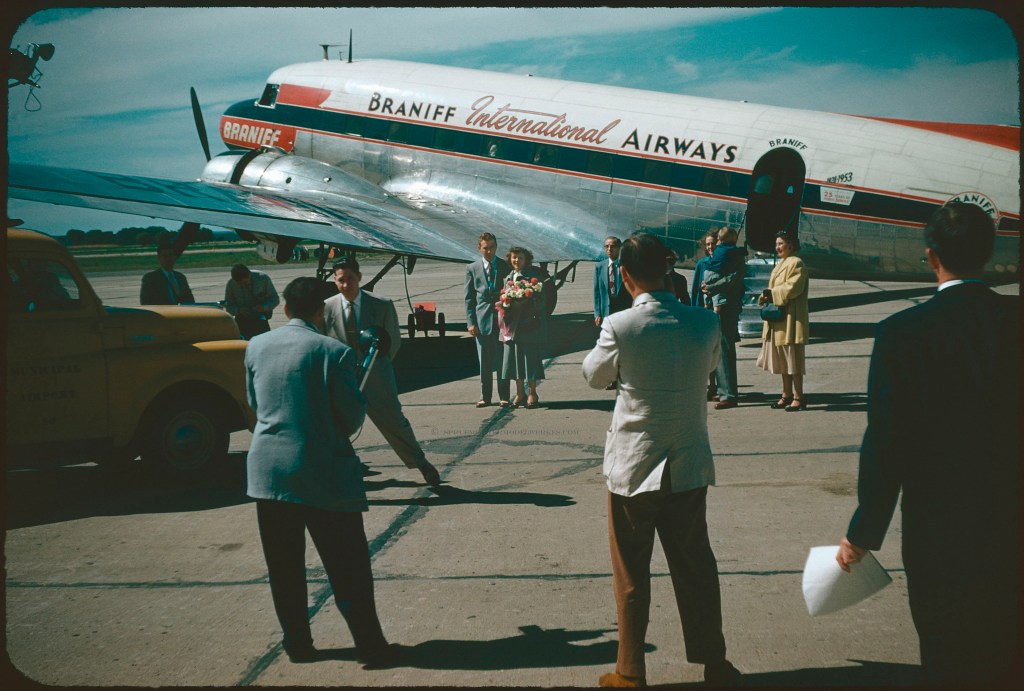
Vaclav Uhlik wasn’t most people either. The former mechanic and two time concentration camp survivor was a planner and a genius with metal. Under communism, he is working as a logger in the Czech forests near his small home near Line. While doing this job he comes across an abandoned WWII armored vehicle, and a new plan begins to form in his head. Working at night in his garage for three years while he secretly listens to the broadcasts of Radio Free Europe, Vaclav transforms the pile of junk into a working, moving getaway car complete with both wheels and tracks as well as military green painted armor plates. The intention is to simply crash the German-Czech border with his family of four inside, disguised as a Czech army vehicle, and become political refugees seeking asylum. The first attempt ends ten miles from home, broken down, but undiscovered. With help from friends the armored vehicle is towed home and Vaclav re-engines the beast with a scrounged salvaged diesel engine. Attempt number two is the stuff of legends and involves three more people; two Czech soldiers who had had enough of the communists and a lovelorn, determined neighbor, Lela Cloud. Lela tells her family she is going to see friends, but says nothing of what is about to happen. Whether succeeding or failing, she knows she will probably never see them again. Seven people in all with Vaclav’s family rumbled through the nighttime forest on July 25th, 1953 to a swampy spot on the border free of landmines and other heavy obstacles. There the tracks were lowered and the wheels raised. The vehicle assaulted the barbed wire, crashing through to West Germany with astonished but stymied Czech border guards behind them. The newly freed refugees entered the town of Waldmunchen and surrendered to the police. Lela asks someone to telegraph Leonard and tell him that she is safe in West Germany. The group is flown to the US, and on her 31st birthday Lela lands in New York on September 14, 1953. Four days later, after eight long years of heartache and hope, disappointment and finally fulfillment, Lela Cloud lands in Sioux City, Iowa and is reunited with her husband Leonard. There to meet her are bands, press coverage, little boys and girls in traditional Czech garb, Boy Scouts, a speech by the Mayor, new in-laws, and a parade through downtown. Her story, along with the others, circles the globe. The world is amazed at the dash for freedom by these brave individuals and by the love that would not die. Or be told no.
Sioux City, Iowa Sept. 18, 1953
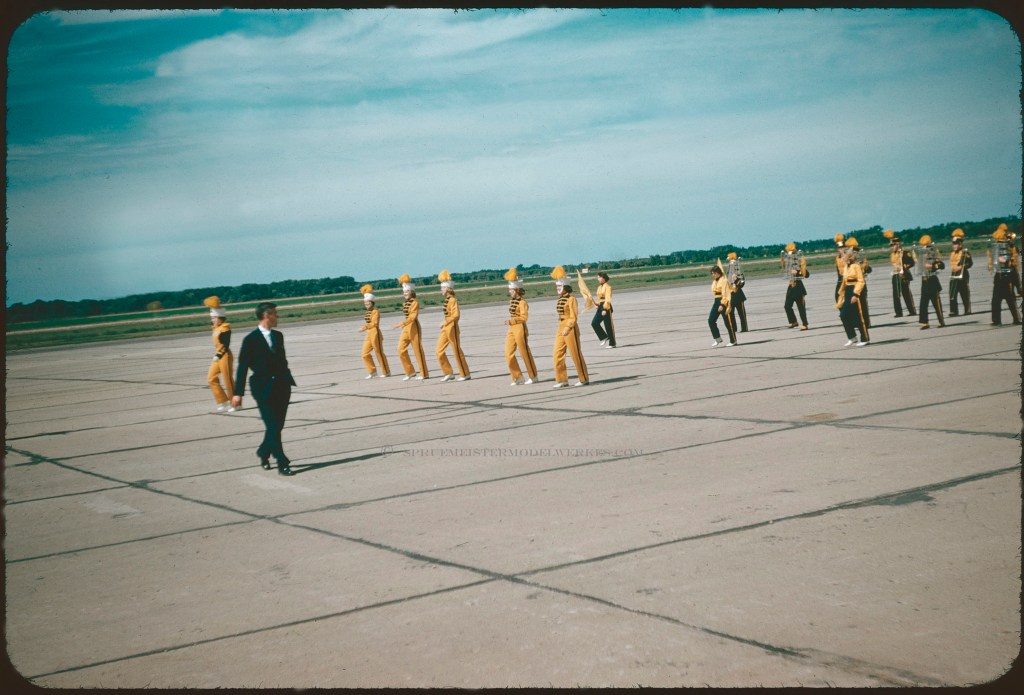
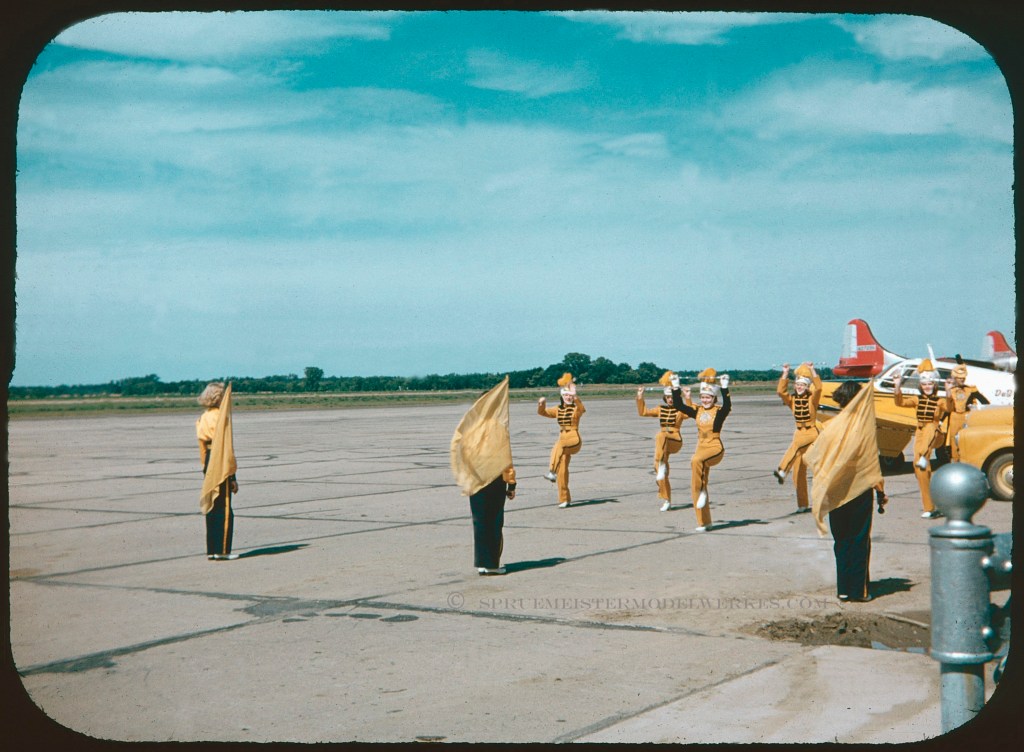
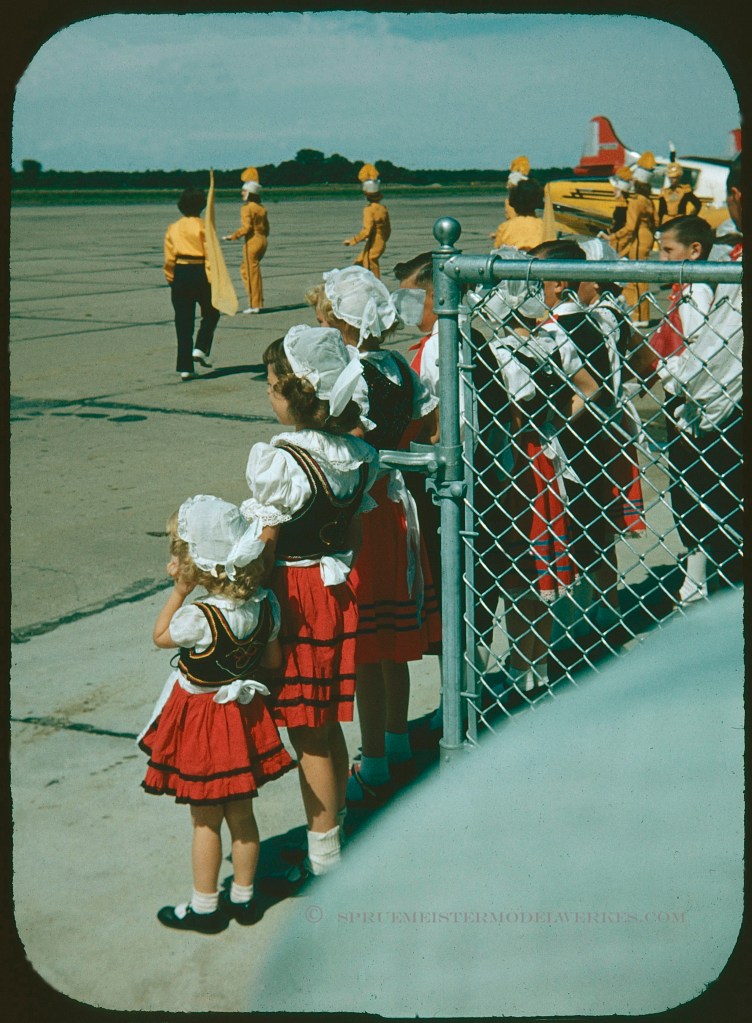
Together again, on the right side of the Curtain.

Leonard and Lela settle down in Sioux City and raise three children. Lela loved Leonard and she loved America, becoming a naturalized citizen April 12, 1957 in Sioux City. Leonard passed away in 1983, and Lela continued on with speaking engagements telling her story and about life behind the Iron Curtain until she passed in 2012.
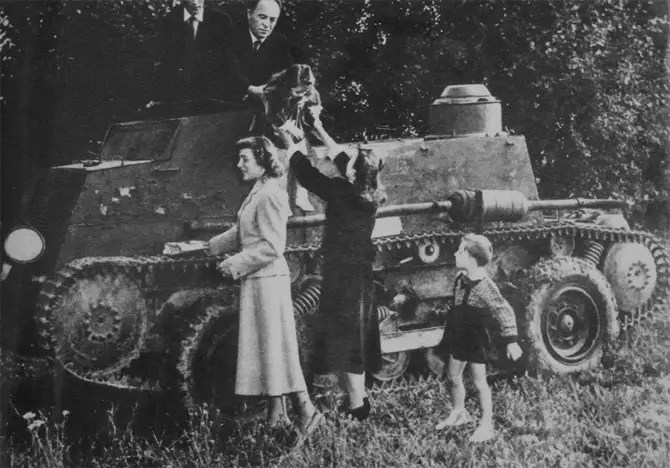
Vaclav Uhlik, his wife Marta, children Vaclav (6), and Eva(4), with Lela in front of the Freedom Tank.
Radio Free Europe of Munich is involved in the lives of the seven refugees from Czechoslovakia before and after their border crossing. They purchase the armored vehicle and send it on a US fund raising tour, telling the story wherever it goes. The Uhlik family often went with it.


The “Freedom Tank” is currently in the hands of a private collector, as far as anyone knows. It has not been seen in quite some time. Perhaps if the right thing happens and this story gets made into a movie someday, it will reappear for new generations to see and learn of its great historical importance, and then we can again remember Lela and Leonard Cloud.
So can I tie all this to scale modeling?
Yep. It is in fact possible. If you are up for a little challenge and don’t mind the work with some imagineering. There are not a lot of photos of the Freedom Tank, but the web does give you a decent enough look at it to set a modeler on the path to duplicating Vaclav Uhlik’s handiwork. Use the references listed at the end as a start point to find images, and the rest is up to you and Google. But you are not left all by yourself in the quest to construct this historic armored vehicle. The basis is already available in the market. The vehicle itself was a Austrian Saurer built RR-7 artillery tractor, which the Nazis used for multiple functions including scout, communication, transport, etc, before it was abandoned in the Czech forest. Not a real “tank”, the vehicle was not armed for offensive operations. Hobby Boss has produced the factory configuration of this duplex drive oddity in 1/35 scale as kit #82491 Sd.Kfz.254 Tracked Armoured Scout Car.
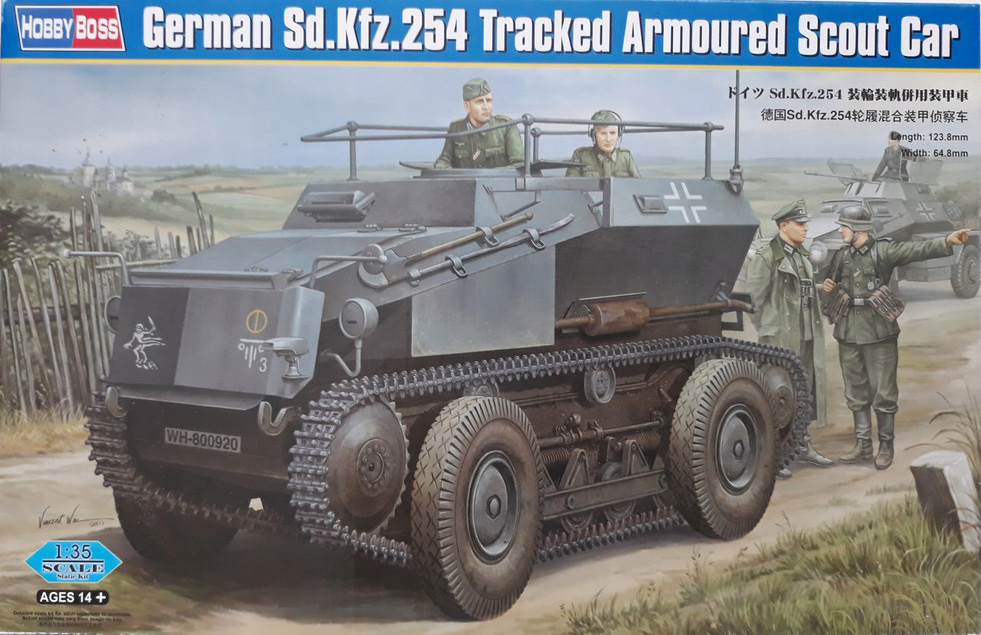
Now obviously it needs a lot of chopping and rebuilding to get to the final modification done by Vaclav, but hey. There it is. At least it won’t be a total scratch build project. And you don’t really have to be a rivet counter along the way. Nobody is ever going to convince you that you did it wrong. Have fun, and enjoy the journey.
There’s also that gorgeous Braniff DC-3 that delivered Lela to Sioux City. Except it wasn’t really a DC-3. Say whaaaat? I was able to enlarge the photo of the aircraft taxiing in and determined the registration under the left wing to be N21914. The tail is obscured in the other photos. I used a list of Braniff operated DC-3 aircraft in the 50s (I love the internet) and found that this air frame is actually a Douglas C-53C which is a version built especially as a troop carrier for the war with 28 seats. It has 8 windows per side instead of 7 (DC-3 & C-48), and an oval passenger only door on the left fuselage side. No large cargo door as with the C-47. Not many were built, but they lived on with the air lines, being perfect for passenger service. The modeling quandary here is that there isn’t a C-53C kit in any scale. And nobody makes any of the Fly Braniff paint scheme markings for the DC-3 family of aircraft either. I did find an out of production Franklin Mint diecast 1/48 Braniff DC-3, but that one is expensive and frankly not our way as modelers. I have hope that someone like Vintage Flyer Decals can be convinced to issue the markings in multiple scales sized for the available DC-3 kits, and we just forge on ignoring the specific C-53C differences. Far too pretty of an airplane to be ignored.

I did say there were airplanes, plural. After the hooplah was gone someone took a nice shot of the north end of the Gateway ramp with 4 visible B-29s, several National Guard F-51D Mustangs, a line of F-86D Sabres from Air Defense Command, the V-tail of the Des Moines Register’s Bonanza, and a single classic Cessna 140 tail. Some of the buildings in this photo are still standing today.
Resources
8th-armored.com
wearthemighty.com
czechoutyourancesors.com
thegazette.com
christysmith.com/obituaries
prop-liners.com/Braniffdc3fleet
I Corinthians 13
 spruemeistermodelwerkes.com